
Chimney Liner Repair in Newark, NJ: Know the Warning Signs Before Winter Sets In
Before you call anyone, run through this quick checklist: Do you smell something acrid or smoky inside your home even when the fireplace isn’t in use? Have you noticed white staining (efflorescence) on your chimney’s exterior brickwork? Is your furnace or water heater venting through a masonry flue that hasn’t been inspected in over three years? If you answered yes to any of those, you likely need Chimney Liner Repair in Newark and Irvington Chimney Sweep is the crew your neighbors in the Ironbound, Forest Hill, and Weequahic sections already call. We are based minutes away in neighboring Irvington, NJ, which means a same-week appointment is almost always available.
A damaged chimney liner is not a cosmetic problem. It is the single most direct path for carbon monoxide and house fires to enter your living space. This page explains exactly what drives liner failure in Newark’s specific housing stock, how we diagnose and repair it, and which neighborhoods we cover so you can make a fully informed decision before picking up the phone.
Why Newark’s Housing Stock Makes Liner Damage More Common Here
Newark is one of the oldest continuously occupied cities in the United States, and that history shows up inside chimneys. The majority of residential flues in neighborhoods like Vailsburg, Silver Lake, and the North Ironbound were built between 1890 and 1945. Those original clay tile liners if they haven’t been replaced are now pushing 80 to 130 years old. Clay tile has a practical lifespan of roughly 50 years under normal use. Beyond that, thermal cycling (the repeated expansion and contraction of clay during heating and cooling seasons) causes tiles to crack, spall, and separate at the mortar joints.
Newark’s urban density creates a second, less obvious hazard: shared or party walls between attached row houses and two-family homes are common throughout neighborhoods like the South Ward and parts of the East Ward near the Passaic River. When a liner deteriorates in an attached home, combustion gases can migrate laterally through deteriorated mortar and into the adjacent unit. We have inspected properties in the Clinton Hill area where a homeowner on one side of a party wall had no fireplace at all and still had carbon monoxide seeping in through a cracked shared flue system.
A third factor is Newark’s ongoing rental conversion and renovation activity. Properties near Rutgers University–Newark on Washington Street and throughout downtown have been subdivided and re-fitted with gas appliances whose BTU output can be mismatched to an original flue size, accelerating liner wear through condensation and acid attack on the clay or mortar.
What a Failing Liner Actually Looks Like a Homeowner’s Walkthrough
You do not need to be a technician to spot early warning signs. Here is what to look for in and around your Newark home:
- Shaling at the firebox floor: Small shards of gray or terra-cotta-colored tile collecting on the floor of your fireplace opening are pieces of your liner falling apart from inside the flue.
- Persistent smoky odor in upper-floor rooms: In Newark’s taller Victorian-era homes in Forest Hill and Newark’s North Ward, a deteriorated liner allows smoke and creosote odor to leach through the chimney masonry into second- and third-floor bedrooms.
- Visible white mineral deposits on exterior brick: Efflorescence on the chimney stack above the roofline signals that water is infiltrating through liner cracks, dissolving salts, and carrying them outward through the brickwork.
- Rust staining on the damper or firebox: Moisture intrusion through a cracked liner corrodes metal components, a reliable secondary indicator of liner failure.
- A CO detector alarm with no obvious source: If your detector triggers in winter when the heating system runs, a deteriorated flue liner on a gas appliance should be the first thing you investigate.
If you checked off even one of those items, stop using the fireplace or appliance connected to that flue and schedule an inspection. Continued use can accelerate the damage significantly.
Our Liner Repair Process from Camera Inspection to Code-Compliant Completion
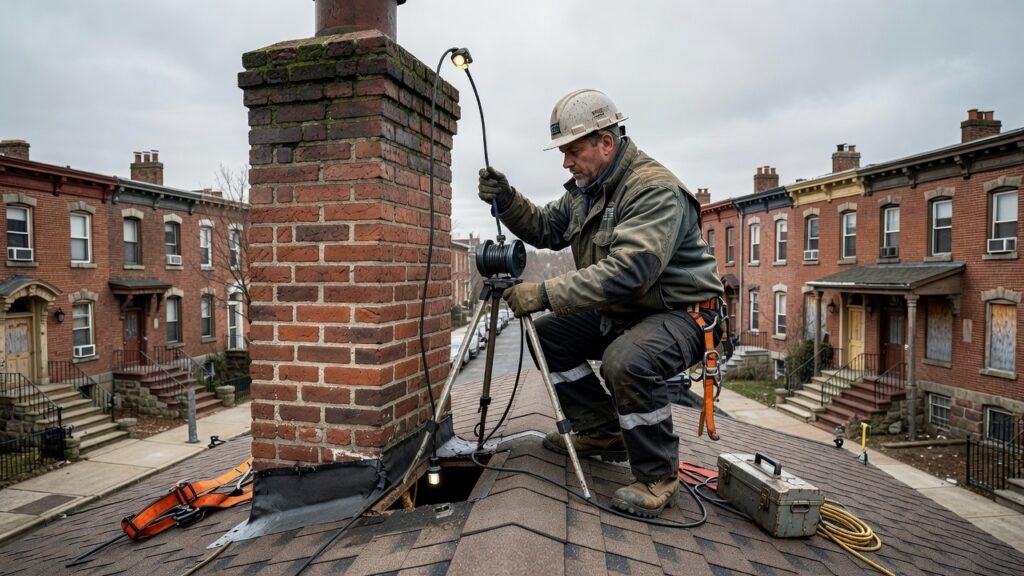
Every liner repair job begins with a Level II video inspection. We lower a high-resolution camera through the full length of the flue, documenting every crack, displaced tile, and mortar joint failure. Newark homeowners receive a plain-language written report with still images before we discuss any repair recommendation. We do not quote liner work without that inspection first any company that does should raise a red flag.
Depending on what the camera reveals, we recommend one of three approaches:
- Targeted tile repair or joint repointing: Suitable when damage is isolated to one or two sections and the majority of the liner is structurally intact. We remove the damaged section, install new code-compliant clay tile, and repoint surrounding joints with high-temperature refractory mortar.
- HeatShield or similar resurfacing system: A poured or brushed ceramic compound applied to a liner with widespread but not catastrophic joint deterioration. This is often the most cost-effective solution for the long row of pre-war flues we encounter throughout Newark’s attached housing stock.
- Stainless steel liner installation: The definitive solution for heavily deteriorated clay tile systems, for any flue being repurposed for a gas insert, or when the original flue diameter does not meet current NJ Uniform Construction Code requirements for the connected appliance. We install UL-listed, 304 or 316 alloy stainless liners with proper insulation and a dedicated top-mount cap.
All work is performed by experienced chimney technicians and, where required by the project scope, coordinated with Newark’s municipal permitting process. We carry full liability insurance and workers’ compensation coverage documentation available on request.
Service Area: Newark Neighborhoods We Cover Regularly
Irvington Chimney Sweep is headquartered in Irvington, NJ, directly adjacent to Newark’s West Ward along the Springfield Avenue corridor. That proximity puts us within 10 to 20 minutes of virtually every Newark neighborhood, and we schedule Newark calls alongside our regular Essex County routes without travel surcharges.
We provide Chimney Liner Repair in Newark across all major residential neighborhoods and ZIP codes, including:
- Ironbound / East Ward (ZIP 07105) — dense two-family and row-house stock along Ferry Street and Frelinghuysen Avenue
- Forest Hill / North Ward (ZIP 07104) — large Craftsman and Victorian single-family homes with tall, original-clay flues
- Vailsburg / West Ward (ZIP 07106) — Cape Cods and colonials built in the 1920s–1940s with active fireplace use
- Weequahic / South Ward (ZIP 07112) — mid-century housing with aging gas-appliance flues
- Clinton Hill / Central Ward (ZIP 07103)
- Silver Lake and Roseville neighborhoods
- Downtown Newark and the University Heights district near NJIT and Rutgers-Newark
- Adjacent communities including Belleville, Bloomfield, East Orange, and Irvington itself
Three Questions Newark Homeowners Ask Us Most About Liner Repair
My home in the Ironbound was built in 1912 and still has the original clay liner. Does it definitely need to be replaced?
Not automatically but it almost certainly needs a Level II inspection before another heating season. A 110-year-old clay liner may still be serviceable if the home was not heavily used for solid-fuel burning, but the odds of cracking and joint separation at that age are very high. Our camera inspection will tell you it’s exact condition. Many Ironbound homeowners we work with discover that a HeatShield resurfacing treatment at a moderate cost extends the liner safely rather than requiring a full stainless replacement.
Newark had several hard winters recently with a lot of freeze-thaw cycles. Does that speed up liner deterioration specifically?
Yes, and it is one of the most underappreciated causes of accelerated liner failure in northern New Jersey. When water infiltrates a hairline crack in a clay tile and then freezes, it expands roughly 9% in volume enough to split the tile further with each cycle. After two or three winters of that process, a minor crack becomes a full spall or a displaced tile section. Newark’s urban heat island effect can also mean more freeze-thaw cycles per winter than surrounding suburban areas because temperatures fluctuate around the freezing point more frequently than they do in consistently colder rural zones.
I rent out the top floor of my two-family in Forest Hill. Can I legally use the fireplace, or does the liner need to be up to code for a rental?
Under New Jersey’s Uniform Construction Code and Newark’s local housing regulations, any wood-burning or gas appliance vented through a chimney in a rental unit must be in safe, code-compliant condition before a tenant uses it. If the liner is deteriorated, you as the property owner bear liability. We regularly work with Forest Hill and North Ward landlords to bring flues into compliance before rental inspections. We can provide a written inspection report and certificate of completed repair work suitable for your records and for the city’s rental certificate process.
Schedule Your Newark Liner Inspection Today
A cracked or deteriorated chimney liner is a problem that does not improve on its own every heating season without repair is a season of added risk and added damage. Irvington Chimney Sweep offers honest, camera-backed assessments with no pressure to sell repairs you do not need. We have earned the trust of homeowners from the Ironbound to Forest Hill by showing up on time, explaining our findings clearly, and doing the work right.
Call us or use the contact form on this page to book your Chimney Liner Repair in Newark. Same-week appointments are typically available, and we are happy to answer questions by phone before you commit to anything. Your home’s safety is the whole point let’s make sure that liner is protecting it the way it should.
Related from Irvington Chimney Sweep: Chimney Liner Repair in Irvington · Chimney Liner Repair in Irvington
Our services
Chimney Liner Repair in Irvington · Chimney Liner Repair in Irvington · Chimney Liner Repair in Irvington · Chimney Liner Repair in Irvington, NJ · Chimney Liner Repair in Irvington · Chimney Liner Repair in Irvington, NJ
Areas we serve
Irvington, NJ · Irvington, NJ · Irvington, NJ · Irvington, NJ